
Table of Contents
- Which Red Light Therapy Devices for Gum Health Are Actually Backed by Science?
- Quick Comparison: Oral Red Light Therapy Devices
- Red Light Therapy Wavelength for Gums: Why 660nm and 850nm Matter
- Red Light Therapy for Gum Disease: What the Clinical Evidence Shows
- Red Light Therapy for Receding Gums: What It Can and Cannot Do
- How We Evaluated These Devices
- Which Device Should You Pick?
- Frequently Asked Questions
Last Updated: October 14, 2026
Which Red Light Therapy Devices for Gum Health Are Actually Backed by Science?
Photobiomodulation research into periodontal disease and gingivitis has expanded quickly, but the gap between laboratory findings and what a consumer device can deliver remains wide. If you are searching for which red light therapy devices for gum health are actually backed by science, the honest answer is that most at-home devices are wellness products, not registered medical devices, and the strongest clinical evidence sits with professionally supervised treatment.

Red light therapy, or photobiomodulation, is the use of specific wavelengths of visible red and invisible near-infrared light to stimulate cellular energy production and support tissue repair. It is not a cure for gum disease, and no consumer device should be marketed as one.
Three things separate a credible device from a gimmick: wavelength, dose, and honest claims. We will show you how to check all three, then compare the devices we stock against those criteria.
Quick Comparison: Oral Red Light Therapy Devices
Every device below uses 660nm red light, and each adds a second or third wavelength for a different purpose. Prices are one-time purchases. The table includes the specifications that determine whether a device resembles a studied protocol: wavelength, session length, and LED count.
| Device | Wavelengths | Session Length | LEDs | Price | Best For |
|---|---|---|---|---|---|
| Oral Red Light Therapy Device | 660nm + 850nm | 15 min red / 10 min dual | 32 | $65.00 | Gum comfort and sensitivity |
| Triple Wavelength Accelerator | 460nm + 660nm + 850nm | 15 min per mode | 24 | $70.00 | Whitening plus gum care |
| Accelerator 3-in-1 | 405nm + 660nm + 850nm | 15 min per mode | 24 | $65.00 | Whole-mouth conditioning |
| Orthodontic Red Light Device | 660nm + 850nm | 5-10 min | 18 | $85.00 | Braces and aligner soreness |
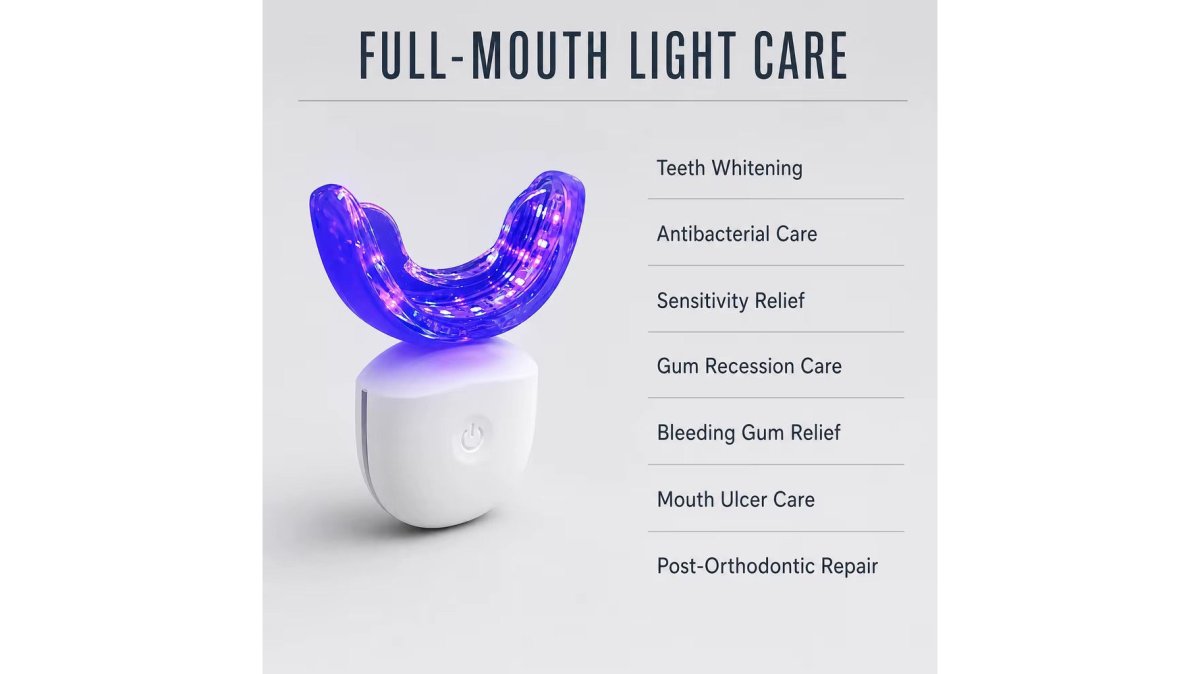
What the specifications actually tell you
Session length is a rough proxy for dose: a 15-minute session at low irradiance can deliver less energy than a 5-minute session at high irradiance. Because most consumer brands do not publish irradiance, session length is the best available comparison, treat it as indicative, not definitive.

LED count affects coverage and uniformity, not power per LED. A 32-LED tray spreads light more evenly across the gumline than an 18-LED tray, which matters for whole-mouth treatment but not targeted areas.
Safety and practical guidance
- Eye safety. These devices emit visible red and invisible near-infrared light. Do not stare into the LEDs. Close your eyes during treatment, and if you have a history of eye conditions, consult an optometrist before use.
- Oral safety. Do not use a device on broken gums, recent extractions, or active oral infections without dental advice. Heat and light can aggravate acute inflammation.
- Cleaning. Wipe the tray with a soft, damp cloth after each use. Do not submerge unless the manufacturer states a water-resistance rating. None of the devices above are dishwasher-safe.
- Fit. A tray that does not sit comfortably against the gumline will not deliver light where it is needed. If you have a small mouth or orthodontic hardware, check the tray dimensions before buying.
- Warranty. Keep your proof of purchase.
Regulatory status and claim verification
In Australia, a product that treats or prevents disease is a medical device and must be registered with the Therapeutic Goods Administration. None of the devices above are registered for gum disease, periodontitis, or gum recession. They are supplied as wellness products, with claims limited to comfort, freshness, and cosmetic appearance. This is the honest regulatory position, and it is why we describe them as adjuncts rather than treatments. If a seller claims their device cures gum disease or regrows gums, that claim is not supported by the device's regulatory status or the clinical evidence.
When to see a dentist instead
If you have bleeding gums that do not improve with good hygiene, loose teeth, persistent bad breath, or visible gum recession, see a dentist before buying any device. These signs need professional diagnosis and treatment, and light therapy is not a substitute for that care.
Red Light Therapy Wavelength for Gums: Why 660nm and 850nm Matter
The red light therapy wavelength for gums determines how deep the light reaches, and that depth decides what it can plausibly affect. Each wavelength, measured in nanometres, penetrates a different layer of tissue.
- 660nm red light is absorbed in the surface layers. It is the wavelength most studied for calming redness and supporting mucosal repair at the gumline.
- 850nm near-infrared passes deeper into periodontal tissue and dentin. It is associated with circulation support and comfort in the structures around the teeth.
- 460nm blue and 405nm violet act on the tooth surface, where they are used for stain management and freshness rather than gum tissue.
A common mistake is assuming more wavelengths automatically means a better gum device. If your goal is gum comfort, blue and violet light do very little for it. Match the wavelength to the outcome you want.
Red Light Therapy for Gum Disease: What the Clinical Evidence Shows
Clinical evidence for red light therapy in dentistry is strongest as an adjunct to professional treatment, not a standalone therapy.
Level 3, Mechanistic or laboratory evidence only. The wavelengths show cellular effects in vitro or in animal models, but no human gum-health trial exists for the device or its protocol class. The Triple Wavelength Accelerator and the Accelerator 3-in-1 sit here for gum claims, because adding 460nm blue or 405nm violet changes the protocol in ways untested for gum outcomes.

Level 4, Manufacturer or marketing claims only. No independent evidence, no published protocol, no verifiable specification. We do not stock devices at this level.
Three limitations explain why even Level 2 evidence should be treated with caution:
- Sample size. Many periodontal photobiomodulation trials enrol fewer than 40 participants, making results harder to generalise and increasing the chance a positive finding is noise.
- Dose variation. Studies use different irradiance, treatment time and session counts, so results are not directly comparable. A device emitting 5mW/cm² for 15 minutes delivers a very different dose from one emitting 50mW/cm² for 5 minutes, even if both claim "660nm red light."
- Supervision and adjunctive design. Most positive findings involve clinician-delivered or overseen treatment alongside scaling and root planing, not home self-administration. The light is one variable among several, and separating its effect from the professional cleaning is difficult.
Publication bias is another limitation: positive trials are more likely to be published, and small null-result trials often are not, so the literature may overstate the average effect.
Oral Red Light Therapy Device – 660nm Red + 850nm Near-Infrared Dual-Wavelength →
Red Light Therapy for Receding Gums: What It Can and Cannot Do
Red light therapy for receding gums can support circulation and comfort in the tissue around the teeth, but it cannot rebuild gum tissue that has already receded. Recession is usually structural, often linked to brushing technique, grinding, or gum disease, and light does not reverse it.
What it can reasonably do is support the conditions that help gums stay comfortable: improved circulation, reduced day-to-day sensitivity, and a calmer gumline. Visible recession is a conversation for your dentist, because the cause determines the fix.
This is also where the distinction between three conditions matters, and most guides blur it:
- Gingivitis is inflammation of the gum tissue, often with bleeding. It is usually reversible with good hygiene and professional cleaning.
- Periodontitis involves the deeper supporting structures and needs professional management.
- Gum recession is a change in gum position, which light therapy will not reverse.
How We Evaluated These Devices
We graded each device on four criteria, weighting wavelength relevance to gum tissue most heavily. A device with a long feature list but the wrong wavelengths for your goal scores lower than a simple one that matches the target.
Our criteria:
- Wavelength relevance. Does it include 660nm and 850nm, the two most associated with gum tissue support?
- Session design. Is treatment time fixed and sensible, with automatic shut-off?
- Claim honesty. Does the product state clearly that it is a wellness device, not a medical treatment?
- Practical fit. Battery life, charging method, water resistance, and comfort in the mouth.
The Therapeutic Goods Administration guidance on medical device claims is a useful reference point here. In Australia, a product that treats or prevents disease is a medical device and must be registered. Our devices are labelled as wellness products because that is what they are.
Which Device Should You Pick?
For most people focused on gum comfort, the Oral Red Light Therapy Device at $65.00 is our pick. It pairs 660nm and 850nm across a 32-LED array, offers a 15-minute red mode and a 10-minute dual mode, and keeps the routine simple enough to stick with.
If you want whitening and gum care in one tray, the Triple Wavelength Accelerator at $70.00 adds 460nm blue light for surface stain management alongside the same red and near-infrared pair.
All four are rechargeable and designed for daily use. None of them replace brushing, flossing, or a dental visit.
Frequently Asked Questions
Does red LED therapy actually work for gum health?
The evidence is mixed but promising. Some randomised clinical trials show that photobiomodulation can reduce gum inflammation and bleeding when used alongside standard brushing and flossing. However, study designs vary widely in wavelength, dose and treatment duration, so results are not directly comparable across devices. A 660nm red light paired with 850nm near-infrared, like the Smile Kit Oral Red Light Therapy Device, targets both surface gum tissue and deeper periodontal structures. It is best treated as a complement to professional dental care, not a replacement.
What wavelength of red light is used for gum health?
Most oral photobiomodulation research uses 660nm red light and 850nm near-infrared light. The 660nm wavelength penetrates shallow gum tissue to support surface healing and reduce redness, while 850nm reaches deeper into periodontal tissue to support circulation and comfort. Devices that combine both wavelengths, such as the Smile Kit Accelerator 3-in-1, offer broader coverage than single-wavelength options. When comparing devices, check that the stated wavelengths match those used in clinical studies.
Are at-home red light therapy devices for gums clinically tested?
Most at-home devices are not independently clinically tested. The clinical evidence base comes from controlled studies using specific wavelengths, doses and treatment times, often with professional-grade equipment. Consumer devices vary in irradiance and dose, so you cannot assume the same results. Look for devices that publish their wavelength specifications and treatment protocols, such as the Smile Kit range, which states 660nm and 850nm with defined session times. Ask your dentist whether a device suits your situation.
Can red light therapy regrow receding gums?
Red light therapy cannot regrow gum tissue that has already receded. Gum recession involves the loss of gingival tissue and sometimes bone, which light therapy cannot reverse. What photobiomodulation may support is blood circulation and tissue comfort in the remaining gum tissue, which some users find helps with sensitivity and mild inflammation. If you have significant recession, see a dental professional. A device like the Smile Kit Orthodontic Red Light Device is designed for comfort support, not tissue regeneration.
Can red light therapy replace treatment for gum disease?
No. Red light therapy is an adjunctive treatment, not a replacement for professional periodontal care. Gum disease, particularly periodontitis, requires assessment and treatment by a dental professional, which may include deep cleaning or other interventions. Photobiomodulation may support comfort and circulation alongside standard care, but it cannot remove calculus, eliminate deep infection or halt disease progression on its own. Always follow your dentist's treatment plan and use any device as a complement.
Gum concerns rarely have a single cause, and the right routine depends on what is actually happening in your mouth. Smile Kit builds devices around that reality: dual-wavelength red and near-infrared technology for gum support, fluoride-free nano-hydroxyapatite toothgels for enamel remineralisation, and vegan, Halal and cruelty-free formulations across the range. Start with the Oral Red Light Therapy Device and build a routine you will keep.
